
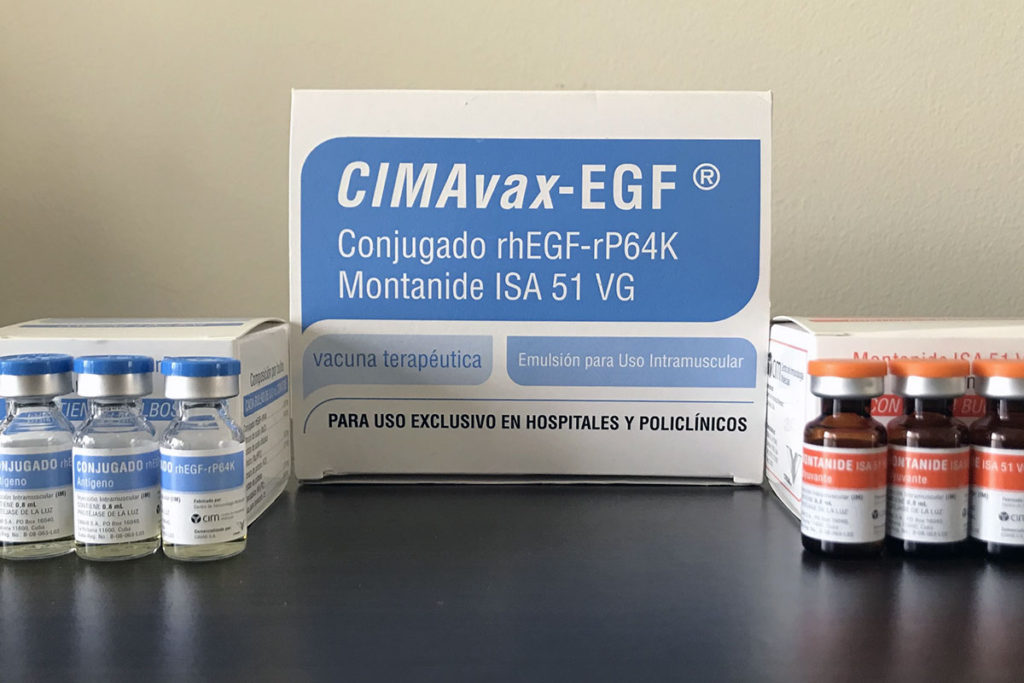
Scope note (freshness): This report prioritizes peer reviewed and registry sources available up to October 2023. Where a registry page has later administrative updates, the trial existence and design remain valid, but no post October 2023 outcomes are used.
1) Effectiveness of CIMAvax EGF Treatment
1.1 Overview and Mechanism
CIMAvax EGF is a therapeutic cancer vaccine designed to induce neutralizing antibodies against epidermal growth factor (EGF), lowering circulating EGF and reducing EGF driven signaling through EGFR in susceptible tumors. AACR Journals+2Frontiers+2
Intended clinical role in NSCLC (based on pivotal trials): predominantly studied as switch maintenance after first line platinum based chemotherapy in advanced disease. AACR Journals+1
1.2 Key Efficacy Evidence for CIMAvax EGF in NSCLC
Phase III randomized evidence (advanced stage IIIB or IV, post chemotherapy)
A large randomized phase III study evaluated CIMAvax EGF as switch maintenance in stage IIIB or IV NSCLCpatients after completion of first line chemotherapy (randomization occurred several weeks after chemotherapy). The trial assessed overall survival, safety, immunogenicity, and serum EGF dynamics. AACR Journals+2QxMD Read+2
What the evidence supports (high level):
- The phase III program supports that CIMAvax EGF can produce an overall survival benefit in selected populations, with serum EGF biology strongly tied to benefit. AACR Journals+2Frontiers+2
- Multiple analyses report that high baseline serum EGF is associated with a greater likelihood of benefit from CIMAvax EGF (predictive biomarker), while also being a poor prognostic factor in unvaccinated controls. Frontiers+2ScienceDirect+2
Biomarker anchored outcomes (predictive enrichment concept)
A pooled analysis of controlled trials further evaluated pretreatment serum EGF as a predictive biomarker and reinforced its role in identifying patients more likely to gain survival benefit. Fortune Journals+1
Additional exploratory signals suggest immune competence markers (for example CD4 counts, CD4/CD8 ratios, immunosenescence related subsets) may correlate with better outcomes, but these require prospective validation. Frontiers+1
1.3 Comparative Analysis Versus “Similar” NSCLC Vaccine Approaches
Comparison class: other therapeutic vaccines historically studied in NSCLC
Several other vaccine platforms were tested in NSCLC over the past two decades, often in maintenance or post chemoradiotherapy settings. Many did not meet primary endpoints in phase III trials.
Tecemotide (L BLP25, MUC1)
- Phase III START did not meet its primary endpoint in the overall population, though exploratory subgroup analyses suggested possible benefit in patients treated with concurrent chemoradiotherapy. The Lancet+1
Belagenpumatucel L (Lucanix, allogeneic tumor cell vaccine)
- A large phase III study in stage III or IV NSCLC maintenance did not demonstrate a statistically significant overall survival improvement in the overall population, with exploratory signals in certain timing or prior radiation subgroups. EJCancer+2VIVO+2
TG4010 (MVA based MUC1 plus IL2)
- Studied as first line therapy combined with chemotherapy in MUC1 positive stage IV NSCLC with biomarker exploration (TrPAL). The program faced development hurdles and the TIME study is listed as terminated in the registry. ClinicalTrials.gov+1
Interpretation across vaccine class (evidence based):
- Compared to many NSCLC vaccines that failed to meet primary phase III endpoints broadly, CIMAvax EGF is notable for having a consistent biomarker rationale (serum EGF) repeatedly linked to benefit and mechanism (EGF depletion), which may support a more targeted use strategy rather than unselected vaccination. Frontiers+2ScienceDirect+2
1.4 Comparative Context Versus Modern Standard Systemic Therapies (Immunotherapy and Chemo)
Checkpoint inhibitors (anti PD 1 or anti PD L1) changed first line management for many metastatic NSCLC subgroups, particularly where PD L1 is high and no targetable oncogenic drivers are present. For example, pembrolizumab demonstrated meaningful overall survival improvements versus chemotherapy in first line PD L1 high disease in KEYNOTE 024. Cancer.gov+1
Important nuance: This does not directly “beat” or “lose to” CIMAvax EGF because:
- CIMAvax EGF pivotal data are primarily maintenance post chemotherapy in advanced stage IIIB or IV populations. QxMD Read+1
- Checkpoint inhibitor trials often evaluate first line strategies stratified by PD L1 and driver mutation status. Cancer.gov+1
Where CIMAvax EGF may be positioned, based on evidence up to Oct 2023:
- As a maintenance oriented immunotherapy with low systemic toxicity signals, potentially most relevant for patients who have completed induction chemotherapy and may be candidates for additional immune based disease control, especially where serum EGF biology suggests susceptibility. AACR Journals+2Frontiers+2
1.5 Conclusion on Effectiveness
- Evidence strength: randomized phase III evidence exists for CIMAvax EGF as switch maintenance after first line chemotherapy in advanced NSCLC, with outcomes tied to biologic markers like serum EGF. AACR Journals+2QxMD Read+2
- Comparative takeaway: among NSCLC vaccine approaches, CIMAvax EGF has a comparatively clearer biomarker linked mechanism and repeated biomarker benefit signals, whereas several other vaccine programs failed phase III primary endpoints in broad populations. The Lancet+2EJCancer+2
- Not a replacement statement: direct head to head comparisons versus checkpoint inhibitors or contemporary chemo immunotherapy regimens are not established in definitive randomized trials as of Oct 2023, so comparative superiority claims should be avoided. AACR Journals+1
2) Prerequisites for CIMAvax EGF Qualification (Clinical and Biomarker Factors)
2.1 Stage of Cancer
Most studied and commonly referenced population: advanced unresectable stage IIIB or stage IV NSCLC. QxMD Read+2AACR Journals+2
Clinical implication: Use outside advanced settings requires separate evidence, as pivotal randomized evaluation focused on advanced disease maintenance. AACR Journals+1
2.2 Previous Treatments
Prior systemic therapy requirement in pivotal program
A central inclusion pattern is completion of first line platinum based chemotherapy with at least stable disease before switching to CIMAvax EGF maintenance. QxMD Read+1
Timing after chemotherapy
Randomization and vaccine initiation occurred weeks after finishing chemotherapy (a post induction window). QxMD Read+1
Clinical implication: The evidence base supports CIMAvax EGF primarily as maintenance, not as a substitute for induction chemotherapy in the studied populations. AACR Journals+1
2.3 Genetic Markers
Not a primary selection requirement in key published phase III evidence. The CIMAvax EGF strategy is not tied to a single actionable tumor mutation (unlike EGFR activating mutations for EGFR TKIs). Instead, its selection signal is primarily host serum EGF and immune response generation. Frontiers+2ScienceDirect+2
Practical interpretation for molecular testing (neutral):
- Standard NSCLC care still typically requires molecular profiling to guide targeted therapies where indicated; CIMAvax EGF qualification in the published Cuban trials is not defined by a required oncogenic driver mutation. AACR Journals+1
2.4 PD L1 Levels
PD L1 is not established as a prerequisite biomarker for CIMAvax EGF.
In combination research with checkpoint inhibitors, patients have been enrolled across PD L1 strata, including low or zero PD L1 groups, but these are early phase or exploratory contexts rather than definitive selection rules. Frontiers+2JTO+2
Clinical implication: PD L1 remains central for selecting certain checkpoint inhibitor strategies, but it is not validated as the key biomarker for CIMAvax EGF monotherapy benefit. Cancer.gov+1
2.5 Type of Cancer (Histology and Disease Category)
Disease category: Non-small cell lung cancer. AACR Journals+1
Histology: Major publications focus on advanced NSCLC broadly rather than restricting to a single histologic subtype, but qualification is best aligned to the exact trial studied population and local protocols. AACR Journals+1
2.6 Biomarkers Most Relevant to CIMAvax EGF Qualification
Baseline serum EGF concentration
High baseline serum EGF has repeatedly been reported as a predictive biomarker for CIMAvax EGF benefit. Frontiers+2ScienceDirect+2
Ability to mount an immune response against EGF
Antibody response magnitude and related immune competence markers have been explored as correlates of clinical benefit, supporting the concept that immune system status can influence outcomes. Taylor & Francis Online+1
3) Potential Treatment Contraindications and Conflicts With Standard NSCLC Therapy
3.1 Drug Interactions
Pharmacologic interaction profile (what is known)
CIMAvax EGF is an immunotherapy vaccine designed to generate anti EGF antibodies rather than a small molecule with classic hepatic metabolism pathways. Published clinical experience emphasizes safety and immunogenicity, with no widely cited metabolism based interaction mechanism. AACR Journals+1
Clinically relevant interaction considerations (evidence anchored and cautious)
Immunosuppressive medications (systemic corticosteroids or other immunosuppressants):
- A biologically plausible concern is reduced vaccine immunogenicity if given alongside significant immunosuppression. While not always framed as a “drug interaction,” it is a functional antagonism of a vaccine dependent mechanism. This concept aligns with the observed importance of immune competence markers for benefit. Frontiers+1
Checkpoint inhibitors (nivolumab or pembrolizumab):
- Early phase combinations have been studied with an emphasis on safety and immune response enhancement, suggesting the combination can be feasible in controlled settings. Frontiers+2JTO+2
- However, as of Oct 2023, these are not definitive phase III comparative data, so combination should be approached as protocol driven rather than assumed standard. Frontiers+1
3.2 Timing of Treatments
Timing relative to chemotherapy
Pivotal trial design used CIMAvax EGF as switch maintenance initiated weeks after completion of first line chemotherapy. This sequencing reduces overlap with acute chemotherapy immunosuppression and aligns with the intended mechanism. QxMD Read+1
Timing relative to checkpoint inhibitors
Combination schedules in early trials include a loading phase for the vaccine alongside nivolumab dosing, then ongoing maintenance schedules, but these are specific to trial protocols and should not be generalized beyond them. ASCO Publications+1
3.3 Patient Health Conditions That May Conflict With CIMAvax EGF Use
Because CIMAvax EGF relies on generating an immune response, the following are commonly relevant clinical considerations (aligned with general vaccine immunotherapy principles and biomarker findings in CIMAvax literature):
- Severely compromised immune function may limit antibody generation and reduce likelihood of benefit. Frontiers+1
- Need for chronic high dose immunosuppression may impair vaccine effect and complicate combined immunotherapy strategies. Frontiers+1
- Poor performance status or uncontrolled comorbidities can affect eligibility in oncology trials and real world maintenance therapy decisions, though exact thresholds depend on the governing protocol. QxMD Read+1
3.4 Other Potential Contraindications and Cautions
Allergy or hypersensitivity risk
As with other vaccines and adjuvanted biologics, hypersensitivity to components is a standard caution, managed according to protocol and clinical judgement. Trial publications emphasize safety monitoring. AACR Journals+1
Immune related adverse events context
CIMAvax EGF alone is generally described as having a favorable tolerability profile in published reports, but when combined with checkpoint inhibitors, clinicians must monitor for the immune related toxicities attributable to checkpoint blockade as well. Frontiers+1
3.5 Practical Recommendations (Clinically Neutral, Protocol Oriented)
- Use evidence aligned sequencing: prioritize the studied approach of post induction, post chemotherapy maintenance timing unless a clinical trial protocol specifies otherwise. QxMD Read+1
- Assess biomarker and host readiness: baseline serum EGF and general immune competence indicators are the most evidence supported enrichment tools discussed in CIMAvax EGF literature. Fortune Journals+1
Avoid unproven combination assumptions: combined use with PD 1 inhibitors appears feasible in early phase studies, but should be considered investigational unless local guidelines or protocols explicitly support it. Frontiers+2JTO+2